
USFans Shipping Cost Guide: Weight, Volume and Parcel Fees
Learn how USFans shipping cost are calculated using actual weight, volumetric weight, parcel dimensions, packaging, domestic delivery and international shipping fees.
GoGo Finder
7/14/202610 min read
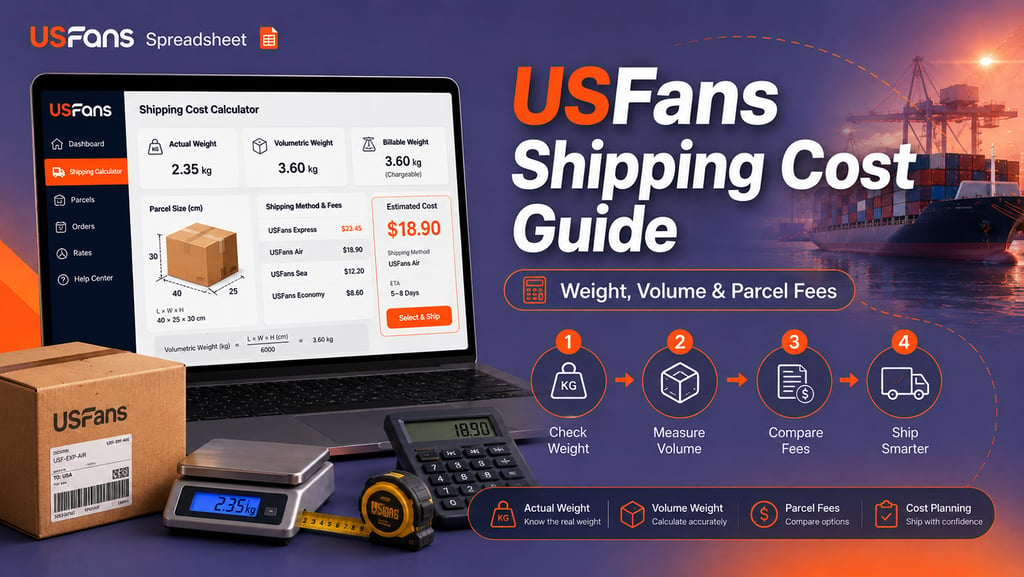
The price shown in a Taobao, Weidian or 1688 listing is not the final cost of receiving a product internationally.
After a product is purchased, it must travel from the seller to the warehouse, remain in storage, be packed into an international parcel and then be transported to the destination country.
Each stage can introduce a different cost.
This is why a low-priced item can become expensive after shipping, while a slightly higher-priced product may still offer better total value if it is lighter, smaller or easier to pack.
Understanding the full cost structure before ordering can help buyers avoid unexpected charges and make better decisions about product selection, packaging and parcel size.
This guide explains how USFans shipping costs may be calculated and which factors have the greatest effect on the final parcel fee.
Product Price Is Only the First Cost
The product price is the amount charged by the marketplace seller for the item itself.
It may not include:
Domestic shipping to the warehouse
Shopping-service charges
Optional inspection services
Storage-related charges
Packaging services
International shipping
Insurance
Customs taxes or import duties
The exact fee structure depends on the platform, seller, parcel and destination.
Before ordering, separate the expected costs into two main stages:
Purchase stage
This can include:
Product price
Domestic seller shipping
Service-related charges
Optional purchase services
International shipping stage
This can include:
Parcel freight
Packaging
Route-specific charges
Optional insurance
Handling or additional services
Keeping these stages separate makes it easier to estimate the complete order cost.
Why Shipping Cost Is Difficult to Predict Early
The exact international shipping price is often not known when the product is first ordered.
This is because the final charge may depend on information that only becomes available after warehouse arrival, such as:
Actual product weight
Product dimensions
Original packaging
Parcel dimensions after consolidation
Shipping-line rules
Restricted product classification
Destination-country availability
Seller listings sometimes provide an estimated product weight, but the figure may not include packaging.
A pair of shoes, for example, may be listed by product weight while the shipping parcel also includes:
Shoe box
Protective material
Outer carton
Warehouse packaging
The estimated figure is useful for planning, but it should not be treated as a final shipping quote.
What Is Actual Weight?
Actual weight is the physical weight of the parcel measured on a scale.
It may include:
Products
Original boxes
Product packaging
Protective materials
Outer shipping carton
Additional packaging services
If a parcel weighs 4.2 kg on the warehouse scale, its actual weight is 4.2 kg.
Some shipping lines charge based mainly on actual weight, especially when the parcel is dense and compact.
Heavy products that occupy relatively little space may include:
Shoes without large boxes
Metal accessories
Hardware
Books
Compact electronics
Dense clothing parcels
However, actual weight is not always the billing weight.
Large parcels may be charged using volumetric weight instead.
What Is Volumetric Weight?
Volumetric weight measures the amount of transport space occupied by a parcel.
It is sometimes called:
Dimensional weight
Volume weight
Chargeable volume weight
A parcel can be physically light but expensive to ship if it occupies a large amount of space.
Common examples include:
Large shoe boxes
Puffer jackets
Hats with rigid packaging
Empty product boxes
Bulky bags
Oversized protective packaging
Shipping companies use volumetric weight because transport capacity is limited by both weight and space.
A large lightweight box can occupy space that could otherwise hold several smaller parcels.
How Volumetric Weight Is Calculated
The general formula uses parcel dimensions:
Length × Width × Height ÷ Volumetric Divisor
Dimensions are usually measured in centimeters, and the result is converted into kilograms.
For example, if a parcel measures:
50 cm × 40 cm × 30 cm
Its volume is:
50 × 40 × 30 = 60,000 cubic centimeters
If the shipping line uses a divisor of 6,000:
60,000 ÷ 6,000 = 10 kg volumetric weight
Even if the parcel physically weighs only 6 kg, the line may charge it as 10 kg.
Different shipping lines can use different divisors, so the same parcel may produce different volumetric weights.
Always review the rules for the selected route.
Actual Weight vs Volumetric Weight
Many shipping lines use the greater of:
Actual weight
Volumetric weight
Example:
Actual weight: 6 kg Volumetric weight: 10 kg Chargeable weight: 10 kg
Another parcel may have:
Actual weight: 8 kg Volumetric weight: 6.5 kg Chargeable weight: 8 kg
This is why parcel dimensions matter.
A buyer may remove only a small amount of physical weight but still reduce the shipping cost significantly if the parcel becomes much smaller.
The opposite can also happen: reducing weight without reducing dimensions may have little effect if the parcel remains volume-charged.
What Is Chargeable Weight?
Chargeable weight is the weight the shipping line uses to calculate the freight cost.
It may be based on:
Actual weight
Volumetric weight
A rounded weight unit
A minimum billable weight
A route-specific pricing rule
For example, a line may round a parcel from 4.15 kg to 4.5 kg or 5 kg.
Another line may price the first 500 grams differently from each additional 500 grams.
The measured warehouse weight is therefore not always identical to the weight used on the invoice.
Review the route’s billing unit before comparing shipping prices.
First Weight and Additional Weight
Some shipping lines use a pricing structure based on:
First weight
Additional weight
The first weight is the opening billing unit and often has a higher base cost.
Each additional unit is then charged at a separate rate.
For example:
First 500 g: fixed opening price Each additional 500 g: additional rate
This can make very small parcels relatively expensive.
A parcel weighing 600 grams may be charged for:
First 500 grams
One additional 500-gram unit
In this structure, combining several suitable items may reduce repeated opening charges.
However, larger parcels can create other issues, so consolidation should still be planned carefully.
How Parcel Dimensions Affect Cost
Parcel dimensions affect:
Volumetric weight
Route eligibility
Maximum side limits
Oversize charges
Packaging requirements
A parcel may be rejected by a particular route if:
One side is too long
Total dimensions exceed the limit
The shape is irregular
The package is difficult to handle
Oversized parcels may require a more expensive shipping line.
Large items can also increase the dimensions of the entire parcel, even when they weigh very little.
Before ordering bulky products, consider whether their size is reasonable relative to their value.
Original Packaging Can Increase Cost
Original packaging may include:
Shoe boxes
Retail display boxes
Protective plastic cases
Gift boxes
Rigid bag packaging
Decorative product packaging
Keeping original packaging can provide protection and may be important for collectors.
However, it can also increase:
Actual weight
Parcel dimensions
Volumetric weight
A shoe box may contribute relatively little physical weight but create a much larger parcel.
Removing it could reduce volumetric charges, but the shoes may need alternative protection.
Packaging decisions should consider both cost and product safety.
Protective Packaging and Added Weight
Warehouse packaging protects products during international transport.
Possible packaging services may include:
Bubble wrap
Corner protectors
Waterproof wrapping
Reinforced cartons
Vacuum bags
Shoe protection
Fragile-item handling
These services can increase weight and dimensions.
The added cost may still be worthwhile for:
Fragile accessories
Structured bags
Electronics
Products with glass
Easily crushed items
Do not remove useful protection only to reduce a small amount of shipping cost.
A damaged product can cost more than the savings achieved by minimal packaging.
Domestic Shipping to the Warehouse
Before international shipping, the marketplace seller must send the product to the agent warehouse.
Domestic shipping may be:
Included in the product price
Charged separately
Based on seller location
Based on quantity
Waived above a minimum purchase amount
A low marketplace price can become less competitive after domestic shipping is added.
When comparing sellers, calculate:
Product price + domestic shipping
This gives a more realistic warehouse-arrival cost.
Domestic returns may also require return shipping, especially if the buyer changes their mind rather than reporting a seller error.
Shopping and Service Fees
Depending on the available services and transaction structure, buyers may encounter charges related to:
Order handling
Payment processing
Currency conversion
Manual purchasing
Product inquiry
Extra photography
Detailed measurements
Repacking
Storage extensions
Not every order includes all of these costs.
Some services may be free within basic limits, while others are optional.
Review the order summary rather than assuming every platform uses the same fee model.
Small charges can become meaningful when applied across many low-value items.
Currency Conversion Costs
Marketplace products are priced in Chinese yuan, while buyers may pay in another currency.
The final converted amount can depend on:
Platform exchange rate
Payment provider rate
Transaction fee
Currency conversion markup
Bank or card fees
The exchange rate shown in a public currency converter may differ from the rate used during payment.
When estimating total cost, allow a small margin for currency conversion.
For larger orders, exchange-rate differences can have a noticeable effect.
Product Weight Categories
Different product categories have different typical weight patterns.
Clothing
Clothing may be compact, but weight varies by material.
Light items include:
T-shirts
Shorts
Thin shirts
Heavier items include:
Hoodies
Heavy jackets
Denim
Thick knitwear
Puffer jackets may be light but create high volume.
Shoes
Shoes often have moderate to high weight.
The box can add both weight and substantial volume.
Bags
Soft bags may pack efficiently.
Structured bags may require protective space and keep their shape.
Accessories
Small metal accessories can be dense.
Lightweight accessories may still require packaging to avoid damage.
Use category characteristics to estimate whether actual or volumetric weight is likely to matter more.
Restricted and Sensitive Products
Some products may qualify as restricted or sensitive goods for shipping purposes.
Examples can include products containing:
Batteries
Liquids
Magnets
Powders
Electronics
Branded or sensitive goods
Pressurized components
These products may have:
Fewer available routes
Higher shipping rates
Special packaging requirements
Additional inspection
Destination restrictions
A lightweight restricted product may cost more to ship than a heavier standard product.
Check route eligibility before ordering when product classification may be an issue.
Minimum Charges and Route Rules
Some lines have minimum fees or minimum chargeable weights.
For example, a route may require:
Minimum 1 kg charge
Minimum parcel fee
Minimum billing increment
Fixed handling charge
This can make one very small item expensive to ship alone.
Other routes may have more flexible pricing for smaller parcels.
Always compare the complete route quote rather than only the per-kilogram figure.
A route with a lower advertised rate may still be more expensive after base charges are included.
Insurance and Compensation
Insurance or parcel protection may be optional or built into the shipping service.
The cost can depend on:
Declared value
Parcel value
Shipping route
Product type
Coverage limits
Before purchasing insurance, review:
What events are covered
Maximum compensation
Required evidence
Excluded products
Claim deadlines
Whether delay is covered
Insurance does not guarantee full reimbursement in every situation.
It is most useful when the coverage terms match the actual parcel risk.
Customs, Taxes and Import Fees
International shipping charges do not always include destination-country customs costs.
Possible additional charges include:
Import tax
Value-added tax
Customs duty
Customs handling fee
Local courier processing fee
These depend on:
Destination country
Declared value
Product category
Local tax rules
Shipping arrangement
Customs rules can change, so buyers should check the current requirements that apply to their destination.
Do not assume that a prepaid shipping fee covers every possible import charge.
Declared Value and Shipping Cost
Declared value can affect:
Customs assessment
Insurance coverage
Route requirements
Import taxes
A declaration should follow the shipping platform’s available process and applicable destination rules.
An unrealistically low declaration can create problems if customs requests evidence or if a compensation claim is based on the declared amount.
The purpose of declaration is not only to reduce tax. It also creates a recorded value for the parcel.
How to Estimate Shipping Before Ordering
A precise final quote may not be available, but buyers can still make a reasonable estimate.
Use the following information:
Estimated product weight
Number of items
Original packaging size
Likely parcel dimensions
Destination country
Product restrictions
Available route pricing
Where possible, compare with:
Previous warehouse weights
Similar product listings
Shipping calculators
Historical parcel examples
Product dimensions
Add a safety margin rather than planning around the lowest possible figure.
Estimate Total Landed Cost
A better buying decision uses the total landed cost rather than the product price alone.
A simple estimate is:
Product price + Domestic shipping + Service and payment charges + Optional services + International shipping + Possible customs charges = Estimated total landed cost
This figure makes it easier to compare products fairly.
For example, a bulky low-priced product may cost more overall than a compact higher-priced alternative.
Why Cheap Products Can Be Expensive to Ship
A product can have poor value after shipping when it is:
Bulky
Heavy
Fragile
Restricted
Packed in a large box
Low in product value
Imagine an inexpensive decorative item that requires a reinforced carton and occupies half the parcel.
Its international shipping share may exceed its purchase price.
Before ordering a low-cost bulky item, ask whether the final delivered value still makes sense.
Why Heavy Products Are Not Always the Worst
Heavy products can sometimes ship efficiently if they are compact.
A dense 5 kg parcel may have:
Actual weight: 5 kg
Volumetric weight: 3.5 kg
It would likely be charged at 5 kg.
A large 3 kg parcel may have:
Actual weight: 3 kg
Volumetric weight: 8 kg
It may be charged at 8 kg.
This shows why size and density matter together.
Weight alone does not determine shipping efficiency.
Common Shipping Cost Mistakes
Avoid these common errors:
Treating the marketplace price as the final cost
Forgetting domestic shipping
Ignoring volumetric weight
Using product weight without packaging
Assuming all routes use the same divisor
Comparing only per-kilogram rates
Ignoring minimum charges
Forgetting optional service fees
Ordering bulky low-value products without estimation
Assuming customs charges are included
Removing necessary protection to save a small amount
Treating an estimated quote as guaranteed
A realistic estimate includes both visible and less obvious costs.
Practical Cost-Reduction Methods
Shipping costs may be reduced by:
Comparing routes using the final chargeable weight
Removing unnecessary retail packaging
Using vacuum packing for suitable clothing
Avoiding oversized low-value items
Reviewing product weight before ordering
Combining compatible items where sensible
Removing unnecessary promotional materials
Choosing products with more efficient dimensions
Using valid shipping coupons where available
Cost reduction should not compromise product protection or violate route requirements.
USFans Shipping Cost Checklist
Before ordering:
Check the product’s estimated weight
Consider whether packaging is bulky
Review domestic shipping
Check whether the product is restricted
Estimate the complete landed cost
Allow for currency conversion
Avoid relying on the product price alone
After warehouse arrival:
Confirm actual item weight
Review packaging dimensions
Check actual and volumetric weight
Review chargeable weight
Compare available route totals
Check optional service charges
Confirm whether insurance is needed
Review destination customs requirements
Final Thoughts
USFans shipping cost depends on more than the number of products in a parcel.
The most important factors include:
Actual weight
Volumetric weight
Parcel dimensions
Packaging
Shipping-line billing rules
Product classification
Destination country
Optional services
The lowest product price does not always produce the lowest delivered cost.
A stronger approach is to estimate the entire order from seller payment to international delivery.
Understanding chargeable weight is especially important. A large lightweight parcel can cost more than a smaller, heavier parcel because transport companies price both weight and space.
Before ordering, consider how the product will be packed and shipped. After warehouse arrival, compare actual parcel data rather than relying on early estimates.
Frequently Asked Questions
How is USFans shipping cost calculated?
Shipping cost may depend on actual weight, volumetric weight, parcel dimensions, destination, product type and the selected shipping line.
What is volumetric weight?
Volumetric weight estimates how much transport space a parcel occupies. It is calculated from the parcel’s length, width and height.
Which weight is used for shipping?
Many routes use the greater of actual weight and volumetric weight. The final billable figure is called chargeable weight.
Does product price include international shipping?
Usually not. The product purchase and international parcel shipment are normally separate payment stages.
Do shoe boxes increase shipping cost?
Yes. Shoe boxes can add weight and significantly increase parcel dimensions, which may raise volumetric weight.
Can I know the exact shipping cost before ordering?
Usually only an estimate is possible before warehouse arrival. The final cost depends on measured weight, dimensions and route availability.
Are customs taxes included in USFans shipping fees?
Not always. Import taxes, duties and local customs fees depend on the destination country and shipment conditions.
Does removing packaging always save money?
No. It helps mainly when packaging reduces actual or volumetric weight enough to change the chargeable weight. Necessary protection should not be removed carelessly.
Recommended Links
→ Browse the USFans Spreadsheet
→ Explore USFans Spreadsheet Guides
→ How to Plan a USFans Parcel and Choose a Shipping Line
→ How to Check USFans Sizing and Measurements Before Ordering