12 Common Mistakes to Avoid When Using the USFans Spreadsheet
Discover 12 common USFans Spreadsheet mistakes involving listings, sizing, QC photos, warehouse deadlines, parcel planning and shipping, plus practical ways to avoid them.
common-usfans-spreadsheet-mistakes
7/14/20268 min read
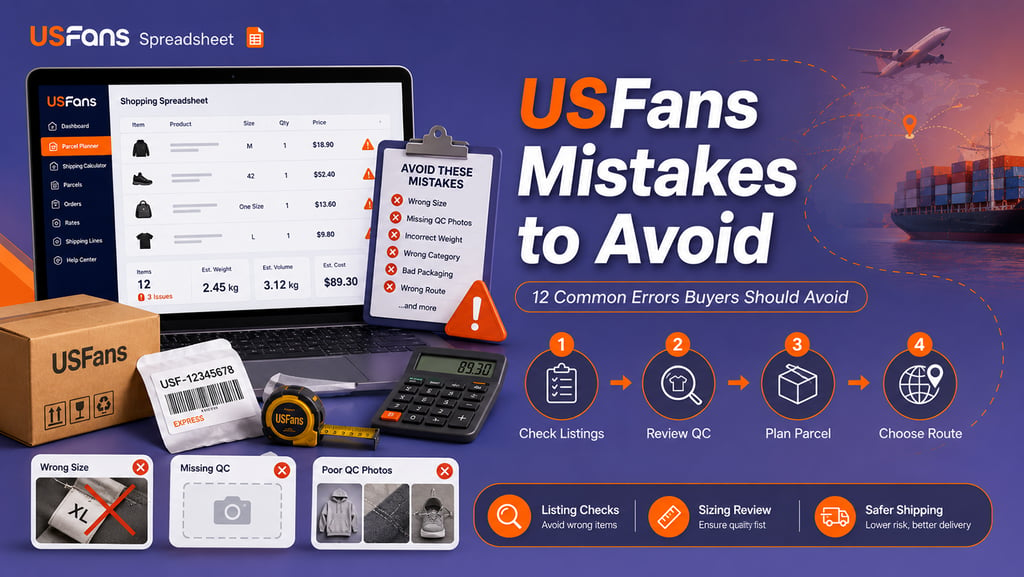
The USFans Spreadsheet can make product discovery easier by organizing marketplace links, categories and buying information in one place.
However, a spreadsheet cannot make every decision for the buyer.
Problems usually happen when users move too quickly from finding a product to submitting an order. A listing may have changed, a size chart may be misunderstood, a QC issue may be missed or a parcel may be created without considering packaging and route restrictions.
Most of these mistakes are preventable.
This guide explains 12 common mistakes buyers make when using the USFans Spreadsheet and provides a practical way to avoid each one.
Mistake 1: Treating the Spreadsheet Entry as the Final Product Page
A spreadsheet entry is a product-discovery reference, not a permanent copy of the marketplace listing.
The seller may change:
Price
Product options
Available sizes
Images
Domestic shipping
Stock
Product version
A spreadsheet thumbnail and short title may still appear correct even when the linked listing has been updated or reused for another item.
Why this matters
Ordering from an outdated reference can result in:
Wrong product selection
Unexpected pricing
Missing size options
Incorrect version
Seller cancellation
How to avoid it
Always open the current Taobao, Weidian or 1688 listing before submitting the order.
Confirm:
The product still matches
The desired option is available
The current price is clear
The seller page is active
The correct quantity can be purchased
Use the spreadsheet to find the product, then use the original listing to verify it.
Mistake 2: Choosing the First Listing Without Comparing Alternatives
Similar products may appear through several marketplace links.
Selecting the first acceptable result can prevent you from noticing meaningful differences in:
Price
Measurements
Materials
Product versions
Seller activity
Domestic shipping
Return support
The first listing may be suitable, but there is no way to know until alternatives are compared.
Why this matters
A small amount of research may reveal that another seller offers:
Better sizing information
More recent QC examples
Clearer product options
Lower complete cost
More flexible returns
How to avoid it
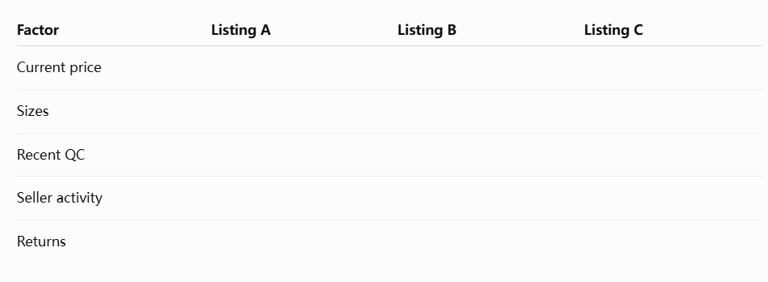
Compare at least two or three relevant listings.
Create a short comparison based on:
The goal is not to research forever. It is to identify the strongest available option before payment.
Mistake 3: Assuming the Lowest Price Means the Best Value
A low product price attracts attention, but it may not reflect the complete cost or product quality.
The cheapest listing may have:
Higher domestic shipping
Limited return support
Unclear measurements
A different product version
Weak seller activity
Poor consistency
A more expensive listing can also be poor value if the price difference is based only on marketing.
Why this matters
A cheap item can become more expensive after:
Return shipping
Reordering
Replacement
Additional QC services
Higher packaging requirements
How to avoid it
Compare total value rather than price alone.
Ask:
What version is being sold?
Are measurements clear?
Is the seller active?
Are recent QC photos available?
Does the price difference correspond to a real improvement?
The strongest listing is usually the one with the best balance of information, suitability and cost.
Mistake 4: Selecting a Size by Label Alone
Size labels such as S, M, L, EU 42 or US 9 are not consistent across every seller and factory.
Two garments with the same label can differ significantly in chest width, length and sleeve measurements.
Shoes with the same printed size can also have different internal lengths.
Why this matters
A visually acceptable product becomes unusable if the fit is wrong.
Sizing problems are especially difficult to solve after international delivery.
How to avoid it
Compare actual measurements.
For clothing:
Measure a similar item you own
Check chest, length, shoulder and sleeve
Confirm whether the chart uses flat width or circumference
Allow for seller measurement tolerance
For shoes:
Measure both feet
Check foot or insole length
Do not use outsole length
Consider width and sock thickness
A measurement is more useful than the label printed on the tag.
Mistake 5: Ignoring Product Options Under One Listing
Marketplace listings often contain several products or versions under one URL.
The main image may show a premium version, while the lowest displayed price applies to:
A basic option
An accessory
A deposit
A smaller size
A different material
A sample product
Why this matters
The buyer may submit the correct listing but select the wrong variant.
The warehouse can then receive an item that is technically consistent with the selected option but not the product the buyer expected.
How to avoid it
Before payment, confirm:
Color
Size
Version
Batch
Quantity
Option-specific price
Use a clear order note when the product option is difficult to understand.
Do not rely on the marketplace cover image to identify the exact selection.
Mistake 6: Treating Historical QC Photos as a Guarantee
Historical QC photos can show how previous warehouse items looked.
They are useful for identifying:
Product shape
Common measurements
Previous materials
Repeated defects
Packaging
However, they do not guarantee that the next item will be identical.
Production may change over time, even when the seller and listing remain the same.
Why this matters
A buyer may approve a purchase based on excellent older QC examples while current production has changed.
How to avoid it
Prioritize:
Recent QC photos
Several different orders
The same size or version
Repeated patterns rather than one ideal example
Use historical QC as research evidence, not a promise.
The final decision should always depend on the actual warehouse photos of your item.
Mistake 7: Reviewing QC Photos Too Quickly
Some users check only the first warehouse image and approve the product immediately.
This can miss:
Wrong size
Wrong color
Missing accessories
Damage
Incorrect version
Measurement problems
Construction defects
Why this matters
After international shipping, returns are usually difficult or economically unrealistic.
The warehouse stage may be the last practical opportunity to correct the problem.
How to avoid it
Review QC photos in a consistent order:
Confirm the correct product
Check color, size and quantity
Inspect overall shape
Review stitching and construction
Check labels and measurements
Look for damage
Confirm accessories
Request an additional photo only when an important detail is missing or unclear.
Do not search endlessly for tiny imperfections, but do not approve before confirming the basics.
Mistake 8: Missing Return or Exchange Deadlines
Marketplace sellers and shopping services may have limited return periods.
A buyer may notice a problem but delay the decision while continuing to research or wait for other warehouse items.
Why this matters
A product that was returnable on arrival may become non-returnable after the deadline.
Possible consequences include:
Keeping an unsuitable item
Paying international shipping for an unwanted product
Losing the product cost
Paying for storage without resolving the issue
How to avoid it
When an item arrives:
Review QC photos promptly
Check measurements
Confirm seller return conditions
Request clarification quickly
Submit return or exchange instructions before the deadline
Resolve product issues before building the international parcel.
Mistake 9: Confusing Product Payment with International Shipping
The first payment usually covers the product and its movement from the seller to the warehouse.
International shipping is normally paid later after the parcel is prepared.
Why this matters
A buyer may assume the product price represents the full delivered cost.
The second payment can feel unexpectedly high, especially for:
Heavy shoes
Large boxes
Bulky jackets
Structured bags
Restricted products
How to avoid it
Estimate the complete cost before ordering:
Product price + Domestic shipping + Service or payment charges + Optional warehouse services + International shipping + Possible customs costs
Do not judge affordability from the marketplace price alone.
Product discovery and international delivery are separate stages.
Mistake 10: Ignoring Volumetric Weight and Packaging
Some buyers focus only on product weight.
However, shipping lines may charge according to volumetric weight when a parcel occupies more space than its actual weight suggests.
Bulky packaging can increase cost even when it weighs very little.
Why this matters
Products such as shoe boxes, hats and padded jackets can create a large chargeable volume.
Removing a small amount of weight may not reduce the cost if the parcel dimensions remain unchanged.
How to avoid it
Before parcel submission, review:
Actual weight
Parcel dimensions
Volumetric weight
Chargeable weight
Original packaging
Route divisor
Remove unnecessary packaging only when product protection will remain adequate.
The goal is efficient packing, not minimal protection.
Mistake 11: Combining Every Warehouse Item into One Parcel
Consolidation can reduce repeated base charges, but one large parcel is not always the best choice.
A combined parcel may become:
Oversized
High in volumetric weight
Ineligible for certain routes
High in declared value
Difficult to protect
More exposed if delayed or lost
Why this matters
One restricted or bulky item can reduce the available shipping choices for every other product in the parcel.
Heavy items can also damage fragile products if they are packed together poorly.
How to avoid it
Group items according to:
Size
Weight
Fragility
Restrictions
Shipping priority
Packaging requirements
Consider separate parcels when:
Products require different routes
One item creates most of the volume
The total value is high
Fragile goods need special protection
Consolidation should improve efficiency, not create a more difficult shipment.
Mistake 12: Choosing a Shipping Line Based Only on Price
The cheapest route may not provide the best overall result.
Shipping lines can differ in:
Tracking
Delivery estimate
Restrictions
Insurance
Dimension limits
Customs model
Final-mile courier
Remote-area support
Why this matters
A cheaper route may have:
Limited tracking
Longer delivery
Lower compensation
Stronger product restrictions
Less suitable local delivery
A faster line may also be poor value if the parcel is not urgent.
How to avoid it
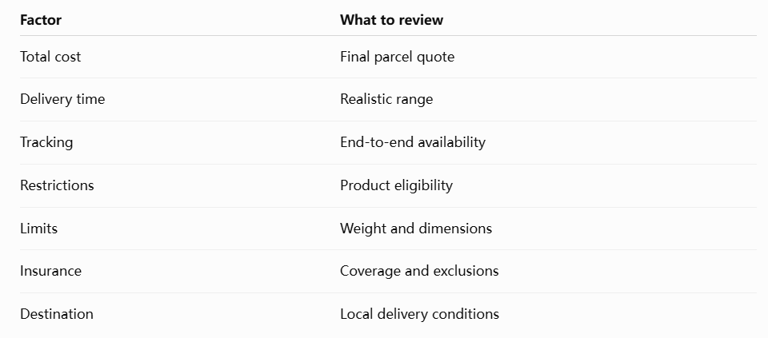
Compare each eligible route using:
Choose the route that matches the parcel, destination and risk level—not simply the lowest displayed number.
A Better USFans Spreadsheet Workflow
The most effective way to avoid these mistakes is to follow a fixed process.
Before ordering
Find the product through the USFans Spreadsheet
Open the current marketplace listing
Compare relevant sellers or versions
Check the correct option and measurements
Estimate the complete delivered cost
After warehouse arrival
Confirm the correct item
Review all QC photos
Verify sizing and important measurements
Return or exchange quickly if necessary
Before international shipping
Review all warehouse items
Plan compatible parcel groups
Compare eligible shipping lines
Confirm packaging and protection
Verify address and customs information
A consistent workflow reduces the need to remember every detail separately.
Quick Pre-Purchase Checklist
Before submitting an order, confirm:
Original listing is active
Product matches the spreadsheet entry
Correct size, color and version are selected
Current price and domestic shipping are clear
Seller information has been reviewed
Recent QC examples are available where possible
Measurements are suitable
Return conditions are understood
Estimated total cost is acceptable
If several important points are unclear, continue comparing listings.
Quick Warehouse Checklist
After the item arrives:
Correct item received
Correct size and color
QC photos reviewed
Measurements checked
Visible damage inspected
Accessories confirmed
Return deadline noted
Keep, return or exchange decision completed
Do not leave unresolved issues until parcel submission.
Quick Parcel Checklist
Before shipping:
Only approved items selected
Compatible products grouped
Restricted items identified
Packaging choices confirmed
Weight and dimensions reviewed
Eligible routes compared
Insurance considered
Declaration reviewed
Address verified
These checks take less time than correcting a preventable shipping problem later.
Final Thoughts
Most USFans Spreadsheet problems do not begin with the spreadsheet itself.
They begin when a buyer assumes that product discovery, product verification and international shipping are the same task.
They are three separate stages:
Discover the product
Verify the product and warehouse item
Plan the international parcel
Each stage requires a different type of decision.
Use the spreadsheet to find products efficiently, but verify the current marketplace listing before ordering. Use QC photos and measurements to evaluate the actual warehouse item. Then plan the parcel according to weight, packaging, restrictions and destination.
Avoiding these 12 mistakes does not eliminate every marketplace or shipping risk, but it gives buyers more control over the process and reduces many preventable costs.
Frequently Asked Questions
Is every USFans Spreadsheet link currently active?
No. Marketplace listings may be removed, changed or reused. Always verify the current product page before submitting an order.
Should I choose the cheapest seller?
Not automatically. Compare product options, measurements, recent QC evidence, seller activity and return conditions before deciding.
Are old QC photos reliable?
They provide useful context, but they do not guarantee current production. Recent examples and your own warehouse photos are more important.
Why is sizing a common USFans mistake?
Seller size labels are not standardized. Actual garment or shoe measurements provide a more reliable basis for choosing a size.
Can I return a product after parcel submission?
Returns usually become much more difficult after the parcel is packed or shipped. Resolve product issues during the warehouse stage.
Why can a lightweight parcel cost so much?
A large parcel may be billed using volumetric weight rather than actual weight, especially when bulky packaging occupies significant transport space.
Is one large parcel always cheaper?
No. Large parcels may face higher volume charges, route restrictions and greater risk concentration.
What is the best USFans shipping line?
There is no single best line for every parcel. The appropriate choice depends on destination, product type, dimensions, cost, tracking and delivery priorities.
Recommended Links
→ Browse the USFans Spreadsheet
→ Explore USFans Spreadsheet Guides
→ How to Use the USFans Spreadsheet: Complete Beginner Guide