USFans Parcel Guide: How to Plan a USFans Parcel and Choose a Shipping Line
Learn how to plan a USFans parcel guide, consolidate warehouse items, manage packaging, compare shipping routes, review restrictions and choose the right shipping line.
GoGo Finder
7/14/20268 min read
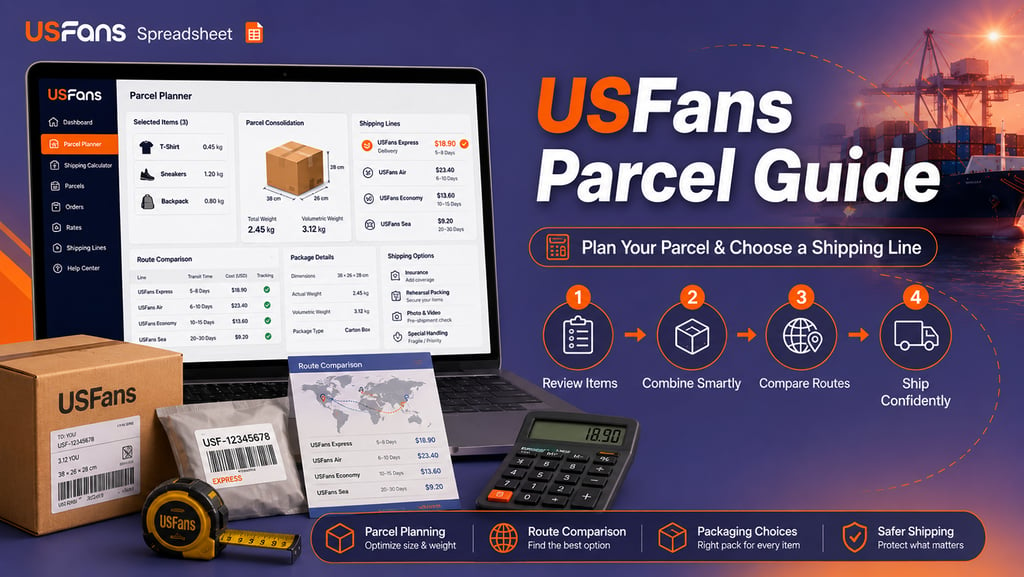
After products arrive at the warehouse and pass QC inspection, the next decision is how to ship them internationally.
This stage is more important than simply clicking the cheapest available route.
Buyers must decide which items to combine, whether original packaging should be removed, how much protection the parcel needs and which shipping line offers the best balance of price, speed, tracking and eligibility.
A poorly planned parcel can become unnecessarily large, expensive or difficult to route. It can also expose fragile products to damage or place restricted items into an unsuitable shipping method.
A stronger approach begins with the products themselves and then compares the available shipping options.
This guide explains how to plan a USFans parcel, consolidate warehouse items and choose a suitable international shipping line.
Confirm Every Item Before Parcel Submission
Do not create a parcel until every included product has been reviewed.
For each warehouse item, confirm:
Correct product
Correct size
Correct color
Correct quantity
Acceptable QC photos
Acceptable measurements
No unresolved damage
Return or exchange decision completed
Parcel submission usually represents the point where products move from warehouse storage into international shipping preparation.
Once the parcel has been packed or dispatched, correcting a product problem becomes more difficult.
If an item still requires:
Additional photos
Measurement confirmation
Seller communication
Return approval
Exchange processing
leave it out of the parcel until the issue is resolved.
Review the Warehouse Inventory
Before selecting products, review the complete warehouse inventory rather than choosing items one by one without a plan.
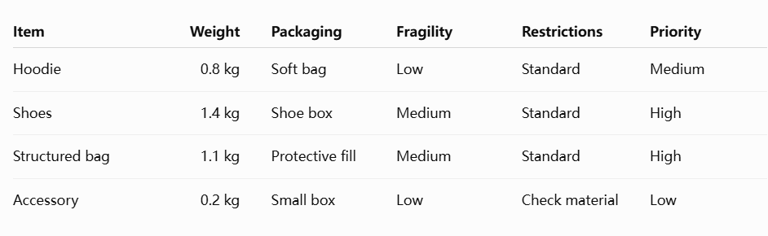
Record useful information such as:
This makes it easier to identify:
Bulky products
Heavy products
Fragile items
Products with route restrictions
Items that can be compressed
Items that should remain protected
Parcel planning is more effective when the complete combination is considered.
What Is Parcel Consolidation?
Parcel consolidation means combining multiple warehouse items into one international shipment.
Instead of paying to ship each product separately, buyers can select several approved items and place them into one parcel.
Potential advantages include:
Fewer opening or base shipping charges
One tracking number
More efficient use of packaging
Easier delivery management
Lower cost per item in some cases
However, consolidation is not automatically cheaper in every situation.
Combining products can also create:
Greater parcel dimensions
Higher volumetric weight
Fewer eligible routes
Higher declared value
Increased loss exposure
More complex customs review
Greater damage risk if items are packed poorly
The decision should be based on parcel efficiency, not simply the number of items.
One Large Parcel vs Several Smaller Parcels
There is no universal best parcel size.
A single larger parcel may be suitable when:
Products are compatible
The route accepts the final size and weight
Base charges are significant
The destination handles larger parcels reliably
Items can be packed efficiently
Several smaller parcels may be more suitable when:
One item is restricted
Products require different shipping routes
The combined parcel becomes oversized
The declared value becomes too high
Fragile items need separate protection
Delivery risk should be divided
Storage deadlines differ
For example, combining soft clothing can be efficient because garments fit together and may be compressed.
Combining a fragile structured bag with heavy shoes may require more careful protection and could increase parcel volume.
Group Compatible Products
Products should be consolidated according to their physical and shipping characteristics.
Suitable combinations may include:
T-shirts, hoodies and trousers
Several pairs of soft footwear without boxes
Small accessories with clothing
Products using the same route category
Less suitable combinations may include:
Fragile items under heavy products
Liquids with clothing
Electronics with strong magnets
Structured bags compressed beside dense items
Products requiring different restricted-goods routes
The parcel should not only fit physically. Its products should also be compatible with the selected shipping line.
Consider the Shipping Priority
Not every warehouse item needs to leave at the same time.
Set a priority for each product:
High priority
Needed by a specific date
Close to storage limit
High-value item
Seasonal item
Product with limited replacement availability
Medium priority
Ready to ship
No urgent deadline
Suitable for consolidation
Low priority
Waiting for more items
Not time-sensitive
Could be included in a later parcel
Shipping a nearly complete parcel may be more sensible than waiting several weeks for one low-priority item.
On the other hand, sending a small incomplete parcel too early may create repeated base charges.
Decide Whether to Keep Original Packaging
Original packaging can provide:
Product protection
Shape support
Easier storage
Collector value
Product identification
It can also increase:
Actual weight
Parcel size
Volumetric weight
Oversize risk
The decision depends on the product.
Packaging that may be removable
Standard shoe boxes
Decorative clothing boxes
Promotional paper bags
Large empty retail cartons
Unnecessary plastic inserts
Packaging that may be worth keeping
Fragile product boxes
Structured bag support
Electronic packaging
Watch or accessory cases
Packaging with important resale or collector value
Do not remove packaging automatically.
A small shipping saving may not justify reduced product protection.
Use Vacuum Packing Selectively
Vacuum packing can reduce the volume of suitable soft products.
It may be useful for:
Hoodies
T-shirts
Jackets without rigid structure
Soft trousers
Bedding or fabric products
It may be unsuitable for:
Structured jackets
Leather or synthetic leather products
Products with fragile printing
Hats
Shoes
Bags that may lose shape
Items with hard decorative parts
Vacuum packing mainly reduces volume, not product weight.
It is most valuable when the parcel is likely to be charged by volumetric weight.
Protect Structured and Fragile Items
Some products need additional protection even when this increases cost.
Examples include:
Structured bags
Watches
Glass accessories
Electronics
Products with hard hardware
Fragile decorative items
Useful protection may include:
Bubble wrap
Corner protection
Internal filling
Reinforced carton
Waterproof outer wrap
Separate product compartment
Heavy items should not be placed directly on top of fragile products.
If one item requires excessive protection, consider whether it should be shipped separately.
Review Parcel Weight and Dimensions
After selecting items and packaging preferences, review the estimated parcel data.
Important figures include:
Actual weight
Estimated dimensions
Volumetric weight
Chargeable weight
Longest side
Total dimensional limit
A parcel can become ineligible for a route because of dimensions even when its weight is acceptable.
Pay special attention to:
Shoe boxes
Large hats
Long accessories
Oversized jackets
Structured bags
Decorative items
If one product creates most of the parcel volume, compare the cost with and without it.
That item may be better placed in a separate parcel or saved for a different route.
Understand Shipping-Line Differences
Shipping lines are designed for different combinations of price, speed, product type and destination.
A route may differ in:
Price
Estimated delivery time
Weight limits
Dimension limits
Product restrictions
Tracking quality
Insurance options
Customs process
Final-mile courier
Remote-area support
A route that works well for clothing may not accept electronics, liquids or batteries.
A route that appears inexpensive may also have slower tracking or less predictable delivery.
Compare the complete service rather than only the displayed price.
Compare Total Route Cost
When reviewing shipping lines, compare the final parcel quote.
Do not focus only on:
Price per kilogram
Instead, compare:
Base fee
First-weight charge
Additional-weight charge
Chargeable weight
Packaging fees
Handling charges
Insurance cost
Remote-area fee
Route-specific surcharge
A line with a lower per-kilogram rate may still cost more after its opening fee and billing increments are included.
Use the same parcel data when comparing routes so the result is fair.
Compare Estimated Delivery Time Realistically
Shipping estimates are usually ranges rather than guarantees.
A route may advertise:
7–12 business days
but the actual delivery can be affected by:
Warehouse dispatch time
Export processing
Flight or vessel availability
Customs clearance
Local courier workload
Public holidays
Weather
Peak shopping seasons
Do not choose a route only because its shortest estimate looks attractive.
Consider how consistent the service is and whether the parcel is time-sensitive.
Review Tracking Quality
Tracking quality varies between shipping lines.
Possible tracking stages include:
Parcel packed
Warehouse dispatch
Export processing
Airline departure
Destination arrival
Customs clearance
Local courier handover
Delivery
Some economical routes provide fewer updates.
A lack of updates does not always mean the parcel is lost. It may simply be moving between tracked stages.
For high-value or time-sensitive parcels, stronger end-to-end tracking may justify a higher cost.
Check Product Restrictions
Before selecting a route, confirm that every item is eligible.
Potentially restricted categories may include:
Batteries
Electronics
Liquids
Cosmetics
Powders
Magnets
Food
Pressurized products
Sharp items
Branded or sensitive goods
Restrictions can depend on both the shipping line and destination.
A route may accept a product for one country but reject it for another.
If the parcel contains mixed categories, one restricted product can remove several otherwise suitable shipping options.
This is a common reason to split parcels.
Consider Destination-Specific Conditions
The best shipping line depends heavily on the destination country.
Review:
Customs practices
Import taxes
Local delivery quality
Remote-area coverage
Address format
Postal code requirements
Product restrictions
Available final-mile courier
A route that performs well in one country may be slower or more expensive elsewhere.
Country-specific experience is more useful than general statements such as “this is the fastest line.”
Review Customs and Declaration Requirements
Before shipping, confirm the declaration process.
The parcel may require:
Product category descriptions
Quantity
Declared value
Recipient information
Customs documentation
Descriptions should be clear enough to identify the contents without being unnecessarily vague.
The declared value may affect:
Customs assessment
Import tax
Insurance
Compensation limits
Route eligibility
Follow the available platform process and destination-country rules.
Do not assume that international shipping fees automatically include all customs charges.
Decide Whether Insurance Is Necessary
Insurance or parcel protection may be useful for:
High-value parcels
Multiple expensive products
Fragile items
Routes with limited compensation
Parcels traveling long distances
Before purchasing coverage, review:
Maximum payout
Covered events
Excluded products
Required documents
Declared-value relationship
Claim deadline
Partial-loss conditions
Insurance does not replace careful packaging or route selection.
It is an additional layer of risk management.
Consider Splitting High-Value Parcels
A large high-value parcel can be efficient, but it concentrates risk.
If one parcel is delayed, damaged or lost, every included item is affected.
Splitting may make sense when:
Total value is high
Products are difficult to replace
Different items require different protection
Route compensation is limited
Customs exposure increases with value
One item is significantly more fragile
The extra base shipping cost may be acceptable if it reduces concentration risk.
Check the Final Parcel Preview
Before payment, review the parcel summary carefully.
Confirm:
Correct warehouse items
Correct quantities
Packaging instructions
Removed or retained boxes
Protection services
Parcel weight
Parcel dimensions
Selected route
Shipping address
Recipient name
Contact number
Declaration information
Insurance selection
A shipping-address mistake can be more difficult to correct than a product-selection mistake.
Check spelling, postal code and apartment or unit information.
Avoid Last-Minute Parcel Changes
Repeatedly changing the parcel after packing may create:
Repacking fees
Delays
New dimensions
New chargeable weight
Route changes
Confusion about included items
Plan the parcel before submitting it.
If the final quote is unexpectedly high, identify the main cause:
One bulky item
Original packaging
Route restriction
Volumetric weight
Oversize limit
Then make a targeted change rather than removing items randomly.
Common Parcel-Planning Mistakes
Avoid these mistakes:
Shipping before QC issues are resolved
Combining every item automatically
Keeping all original packaging without review
Removing protection from fragile products
Mixing restricted and standard products
Comparing routes only by price
Ignoring dimension limits
Choosing the fastest estimate without checking reliability
Forgetting destination-specific restrictions
Declaring the parcel carelessly
Building one very high-value parcel without considering risk
Submitting an unverified shipping address
Good parcel planning connects product protection, cost and route eligibility.
Practical Parcel-Planning Workflow
Use this order:
Approve all products
Review warehouse inventory
Group compatible items
Separate restricted products
Decide which packaging to keep
Select protective services
Review estimated dimensions
Check actual and volumetric weight
Compare eligible routes
Review tracking and insurance
Confirm customs information
Verify the shipping address
Submit and pay
This process reduces unnecessary repacking and makes route comparison easier.
USFans Shipping-Line Comparison Table
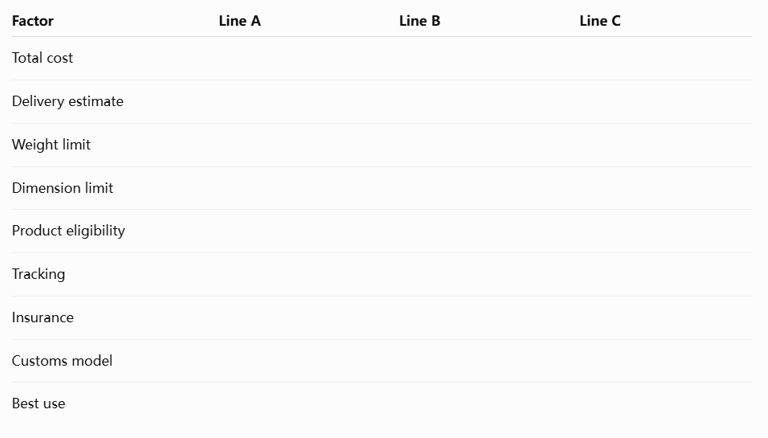
Use a simple table before choosing:
Add specific notes such as:
cheapest for compact clothing parcels
accepts battery product
stronger tracking
unsuitable for large shoe boxes
higher price but faster local delivery
These notes are more useful than labeling a route simply “good” or “bad.”
Final Thoughts
Planning a USFans parcel requires more than selecting warehouse items and comparing one price number.
A suitable parcel should balance:
Product compatibility
Packaging efficiency
Physical protection
Actual and volumetric weight
Shipping-line restrictions
Delivery speed
Tracking
Insurance
Customs requirements
Total risk
The cheapest route is not always the best route, and one large parcel is not always more efficient than several smaller ones.
Begin with the products, identify their packaging and restriction needs, then compare only the routes that can handle the parcel correctly.
A carefully planned parcel can reduce unnecessary cost while protecting the products and improving the overall shipping experience.
Frequently Asked Questions
What is USFans parcel consolidation?
Parcel consolidation means combining several approved warehouse items into one international shipment.
Is one large parcel always cheaper?
No. Larger parcels may face higher volumetric weight, dimension limits, restricted routes and greater risk concentration.
Should I remove shoe boxes?
Removing shoe boxes can reduce volume, but the decision depends on protection needs, collector value and the selected shipping method.
Can clothing be vacuum packed?
Soft clothing may be suitable for vacuum packing, but structured, fragile or easily deformed products should not be compressed carelessly.
How should I choose a USFans shipping line?
Compare total price, delivery estimate, route restrictions, tracking, weight limits, dimensions, insurance and destination-country conditions.
Why are some shipping lines unavailable?
A line may be unavailable because of parcel weight, dimensions, product restrictions, destination or temporary route conditions.
Should high-value products be shipped separately?
Sometimes. Splitting high-value or fragile items can reduce concentration risk, although it may increase base shipping charges.
Can I change a parcel after submitting it?
Changes may be possible before dispatch, but they can cause repacking fees, delays and new weight or dimension calculations.
Recommended Links
→ Browse the USFans Spreadsheet
→ Explore USFans Spreadsheet Guides
→ USFans Shipping Cost Guide: Weight, Volume and Parcel Fees